
The Split
Analysing the left/right lean of Australian media and social media

What follows is an experiment based on US newsletter Ground News, which analyses the left/right lean of the media over there. I’ve added a survey of Australian social media, which I think helps create and complete a picture of the whole spectrum to inform everyone, regardless which bubble you live in. The report is compiled by AI and is not yet comprehensive - I’ll look at adding further outlets for analysis and would be really keen for everyone’s input on which should be included.
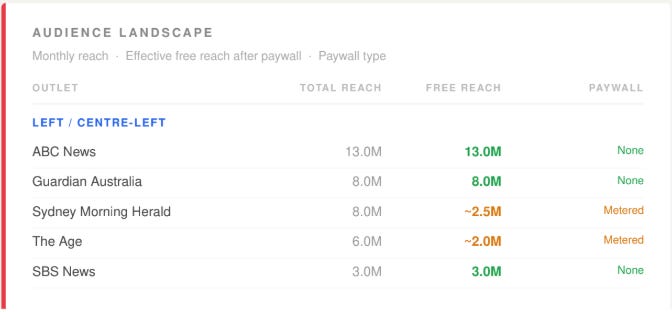
Each week, The Split scans 14 Australian news outlets across the political spectrum and surfaces the gaps — stories the left ignores, stories the right ignores, and stories both sides cover but frame entirely differently. Coverage is weighted by effective free reach: audience size discounted for paywall access. A story broken behind a hard paywall counts for less than one published freely.
Week of 7 June 2026 · Issue #1
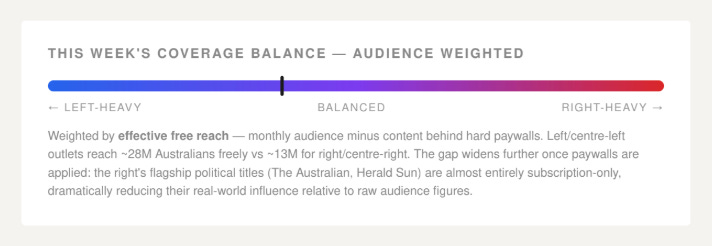
This week’s coverage balance
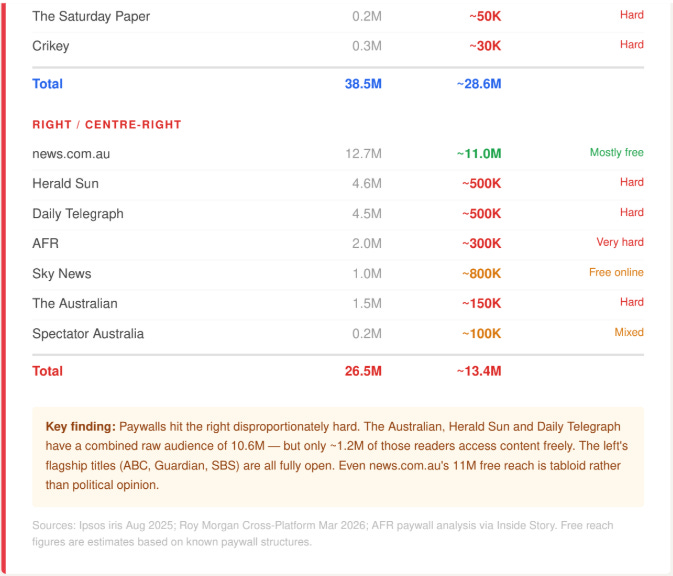
Weighted by effective free reach, this week skews moderately left. Left and centre-left outlets collectively reach around 28 million Australians freely each month, versus roughly 13 million for right and centre-right outlets. The gap is driven by two structural facts: ABC News (13M, no paywall) dominates the landscape, and the right’s flagship political titles — The Australian, Herald Sun, Daily Telegraph — are almost entirely behind hard paywalls, limiting their real-world reach to a fraction of their raw audience figures.
On a story-count basis, this week is close to balanced. Both sides leaned into their respective frames on wages and housing. Audience weighting reveals the structural asymmetry.
Audience landscape
Left Lens — stories the left is covering
Prominent on left-leaning outlets this week — receiving little or no coverage on the right.
Australia’s 2035 emissions targets: what they mean for workers and communities
Left-leaning outlets gave front-page prominence to the government’s newly legislated 2035 emissions reduction targets, framing them as a historic climate commitment and exploring transition support for fossil fuel workers in regional Queensland and NSW.
Covered by: ABC News (13M) · SBS News (3M) · Guardian Australia (8M) · The Age (6M) · SMH (8M)
NDIS review: advocates warn proposed changes could leave thousands behind
Disability advocates and community legal centres raised alarms this week over draft NDIS eligibility changes, with multiple left-leaning outlets running detailed investigations. Right-leaning outlets largely did not cover the story.
Covered by: ABC News (13M) · Guardian Australia (8M) · SBS News (3M) · Crikey (300K)
Albanese secures Solomon Islands treaty to counter Chinese influence in Pacific
The Guardian and ABC gave prominent coverage to Australia’s diplomatic push in the Solomon Islands, framing it as a constructive engagement strategy. Right-leaning outlets carried brief wire reports but did not editorially engage with the story.
Covered by: Guardian Australia (8M) · ABC News (13M) · SMH (8M)
Right Lens — stories the right is covering
Prominent on right-leaning outlets this week — receiving little or no coverage on the left.
Retailers hammered by weak demand and rising costs — and the government has no plan
News Corp outlets and Sky News ran a sustained series on Australia’s struggling retail sector, attributing the pain to Labor’s economic management and calling for tax relief. Left-leaning outlets covered retail weakness as a cost-of-living story without the political framing.
Covered by: The Australian (1.5M, paywalled) · Herald Sun (4.6M, paywalled) · Daily Telegraph (4.5M, paywalled) · Sky News (1M)
Immigration still driving housing unaffordability, economists warn
Despite house prices falling in some markets, right-leaning outlets kept focus on immigration as the structural cause of housing unaffordability, citing economists who argue demand from migration is outpacing supply. Left outlets covered falling prices as a positive sign.
Covered by: The Australian (1.5M, paywalled) · Herald Sun (4.6M, paywalled) · news.com.au (12.7M) · Spectator Australia (200K)
Fuel security crisis: is Australia prepared for another Iran-style disruption?
Following the government’s announcement of additional diesel reserves for Queensland, Sky News and The Australian ran opinion pieces questioning whether Australia’s broader fuel security strategy is adequate amid ongoing Middle East tensions.
Covered by: Sky News (1M) · The Australian (1.5M, paywalled) · AFR (2M, paywalled)
Common Ground — both sides covering, differently
These stories appeared across the spectrum. The framing tells two very different stories.
Wage umpire lifts minimum wage — unions cheer, employers warn of job losses
The Fair Work Commission’s annual minimum wage decision was covered universally, but outlets made sharply different choices about whose voice to lead with.
Left framing: “Workers get a much-needed cost-of-living boost as real wages continue to recover.” Leads with union reaction and worker testimonials. The wage umpire’s expressed “regret” is a footnote.
Right framing: “Employers warn the rise will accelerate job losses in hospitality and retail.” Leads with business reaction. The wage umpire’s “regret” is the headline.
Covered by: ABC (13M) · Guardian (8M) · SMH (8M, paywalled) · The Australian (1.5M, paywalled) · Herald Sun (4.6M, paywalled) · Sky News (1M)
House prices are falling — but is that actually good news?
Left framing: “Prices falling, but affordability remains out of reach for first-home buyers.” Focus on structural barriers: deposits, wages, lending. Government housing programs cited positively.
Right framing: “Falling prices threaten household wealth and super balances for millions.” Focus on the risk to existing homeowners. Labor policy uncertainty cited as a cause.
Covered by: ABC (13M) · SMH (8M, paywalled) · The Age (6M, paywalled) · AFR (2M, paywalled) · The Australian (1.5M, paywalled) · news.com.au (12.7M)
Socceroos squad named for FIFA World Cup 2026 — Ryan and Leckie make history
Coach Tony Popovic named his squad with skipper Mathew Ryan and Mathew Leckie equalling the Australian record of four World Cup appearances.
Left framing: Focus on the multicultural makeup of the squad and what it represents for Australian identity. SBS led with the diversity angle.
Right framing: Focus on the economic boost from fan spending abroad and national pride. The estimated $25,000-per-fan packages covered prominently.
Covered by: ABC (13M) · SBS (3M) · SMH (8M, paywalled) · Herald Sun (4.6M, paywalled) · Daily Telegraph (4.5M, paywalled) · news.com.au (12.7M)
Blind Spots
The story the left missed
Australia’s struggling retail sector got sustained attention from News Corp and Sky News this week, with detailed reporting on collapsing consumer spending, rising input costs, and small business closures across suburban high streets. Left-leaning outlets covered cost-of-living pressure on households but largely ignored the business side — leaving the policy question of what relief, if any, a Labor government owes struggling retailers almost entirely unexamined.
The story the right missed
Draft NDIS eligibility changes that disability advocates warn could strip support from thousands of Australians received extensive coverage in the ABC, Guardian and SBS — including first-hand accounts from families facing potential loss of services. Right-leaning outlets ran no original reporting on the story. A policy that directly affects over 600,000 Australians went essentially uncovered on half of the country’s media landscape.
Platform Pulse — where does Australian social media stand?
Political lean, key demographics, and the top three topics driving each side’s conversation this week across Australia’s major social platforms.
Bottom line up front: Six of seven major platforms lean left in Australia. The exception is Facebook. The right’s social media reach depends almost entirely on Facebook (older demographics) and X’s algorithm (not its user base). TikTok, Instagram, Reddit and Bluesky all skew left. Substack splits by discipline.
X (formerly Twitter) — Moderately right-leaning
70.7% male · largest group 25–34 · ~6M Australian users
Algorithm-driven right tilt. A 2026 Nature study confirmed X’s feed pushes users toward conservative positions with lasting effects. Active political posters skew right; the registered user base is slightly left. Post-Musk, right-wing content receives disproportionate amplification. Top Australian political influencers include Claire Lehmann (Quillette), Sydney Watson, and Nick Adams on the right; Greens Senator David Shoebridge on the left.
Left is talking about:
AUKUS & defence spending (Shoebridge trending #9 today)
#insiders — live-tweeting ABC’s politics show (#1 trend today)
Wage rise & workers’ rights after Fair Work decision
Right is talking about:
Immigration & “remigration” — Jacinta Price podcast controversy
Hegseth & US conservative politics (trending #21 today)
Cost of living as Labor’s economic failure
TikTok — Left-leaning
53.6% male · largest group 25–34 · ~9M Australian users (16+)
Left-leaning, driven by a Gen Z and Millennial base that voted heavily Labor and Greens in 2025. During the election, Labor racked up 4.97M cumulative TikTok views versus Dutton’s 1.23M. The Greens had the highest share of policy content (60%) and performed strongly with climate messaging. One Nation’s attempt at TikTok was widely mocked. The platform’s authenticity culture rewards progressive framing.
Left is talking about:
Housing affordability — renters sharing cost-of-living stories
Climate action — Greens content dominates #auspolitics
Medicare & free healthcare — Labor’s core TikTok message
Right is talking about:
Immigration & housing — One Nation-adjacent creators
Cost of living — economic grievance content
Nuclear energy — Coalition’s alternative energy messaging
Instagram — Moderately left-leaning
54.8% female · largest group 25–34 · ~14.5M Australian users
Moderately left-leaning, shaped by its young, female-skewing demographic. Political content is less prominent than on X or TikTok — Instagram’s culture prioritises aesthetics and lifestyle — but when politics surfaces it skews progressive. Indigenous rights, climate activism and social justice content performs well. Right-wing presence is largely limited to small-business and religious community accounts.
Left is talking about:
Indigenous rights & treaty — visual storytelling dominates
Climate anxiety — youth-led creator accounts
LGBTQ+ visibility & anti-hate speech
Right is talking about:
Small business cost pressures — entrepreneur creators
Faith & family values — religious community accounts
Anti-”woke” lifestyle content — fitness & conservative identity
Facebook — Slightly right-leaning (among active political users)
50.9% female · largest group 25–44 · ~16M Australian users · Gen X & Boomers most loyal
The most contested and right-friendly of the major platforms. Older demographics — who are more likely to vote conservative — are Facebook’s core Australian political users. Baby Boomers and Gen X dominate political groups, and right-wing community pages (anti-immigration, cost-of-living grievance, pro-coal) have large, active followings. However, Labor-aligned community pages and union groups also maintain significant audiences.
Left is talking about:
NDIS funding & disability services — community advocacy groups
Public school funding — parent and teacher network groups
Aged care standards — dominant in Boomer-heavy groups
Right is talking about:
Immigration — the single biggest right-wing Facebook topic
Cost of living as Labor’s failure
Anti-ABC sentiment in conservative pages
Bluesky — Strongly left-leaning
~800K Australian users · grew rapidly post-2024 US election
The most left-leaning major social platform in Australia by a significant margin. Research shows 60% of links shared on Bluesky go to left-wing sites; only 8% to right-wing. The platform grew explosively after Musk’s X takeover as a refuge for left-leaning users, journalists and academics. Australian political journalists, ABC reporters and Greens-aligned voices are disproportionately represented. Right-wing Australian accounts are almost entirely absent.
Left is talking about:
Media accountability & News Corp criticism
AUKUS opposition & peace movement
Climate justice & fossil fuel divestment
Right-wing presence on Bluesky is negligible — the platform is a near-uniform left space.
Reddit — Left-leaning
Predominantly male · 18–34 dominant · ~5M Australian users
Left-leaning, particularly r/AusPol and r/australia — the two largest Australian political communities. A QUT Digital Observatory analysis of 20 politically active Australian subreddits during the 2025 election found intense anti-Dutton sentiment, with frequent comparisons to Donald Trump. Cost-of-living concerns dominate but are framed as systemic failures rather than immigration-driven. Right-wing views exist in smaller subreddits but are a small fraction of total engagement.
Left is talking about:
Rental crisis & housing supply failure — r/australia’s perennial top topic
Nuclear power rejection — the Coalition’s plan heavily scrutinised
Strategic voting & teal/Greens support
Right is talking about:
Labor immigration levels & the housing connection
Free speech & anti-moderation complaints
Economic critique of the Albanese government
Substack — Balanced (split by discipline)
Millennials & Gen X · educated · small but influential Australian community
The most ideologically balanced platform — and the most intellectually serious. Australian political Substack divides roughly along disciplinary lines. Economics and policy newsletters lean right-to-libertarian (Stephen Kirchner’s Institutional Economics, Chris Berg’s Every Point a Good Point, Scott Prasser’s Policy Insights). Political and social commentary leans left (John Quiggin’s socialist economics newsletter, Tim Dunlop on democracy, New Politics). Unlike other platforms, Substack’s algorithm doesn’t amplify content — readers actively subscribe, so audience size directly reflects genuine interest.
Left is talking about:
Democracy & media reform (Tim Dunlop, New Politics)
Socialist economics & inequality (John Quiggin)
Housing planning failures from a progressive angle (Planned Chaos)
Right is talking about:
Free markets & deregulation (Kirchner, Berg, Allen)
Conservative public policy critique (Scott Prasser)
Defence & national security (Mick Ryan, Futura Doctrina)
The Split is published every Friday afternoon. We track 14 Australian news outlets across the political spectrum: ABC News · SBS News · Guardian Australia · The Saturday Paper · Crikey · Sydney Morning Herald · The Age · Australian Financial Review · The Australian · Herald Sun · Daily Telegraph · news.com.au · Sky News Australia · Spectator Australia.
Political lean ratings are editorially assigned. Story selection is based on prominence and coverage volume. Audience figures: Ipsos iris Aug 2025; Roy Morgan Cross-Platform Mar 2026. Social media data: Sprout Social 2026; QUT Digital Observatory; Pew Research / TechCrunch; Nature (2026).